
Are Bishops Biblical?
The Case for Episcopal Government

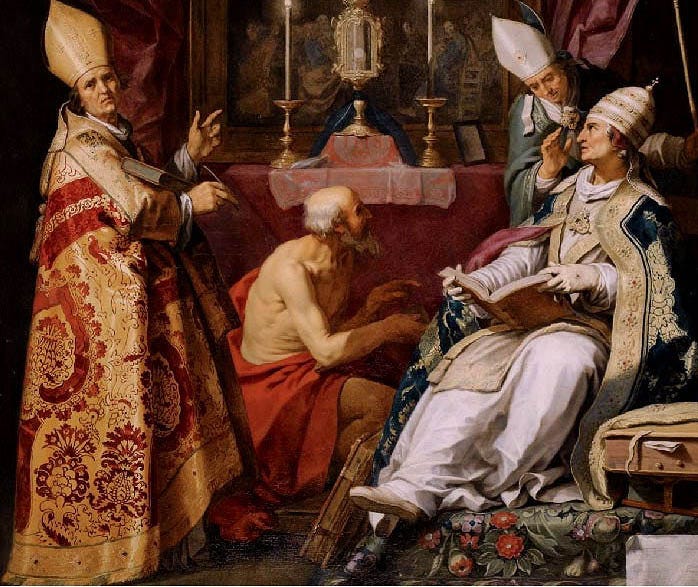
Maybe your church is led by a senior pastor or a teaching elder. But many denominations have bishops as the overseers over priests, deacons, and the laity.
Of course, not everyone agrees that churches should be led by a bishop.
Many commentators assert that the biblical offices of overseer (episkopos) and elder (prebyteroi) are synonymous and there is no biblical equivalent of a Christian leader over a city or regional area.
The reason I left you in Crete was that you might put in order what was left unfinished and appoint elders in every town, as I directed you. An elder must be blameless, faithful to his wife, a man whose children believe and are not open to the charge of being wild and disobedient. Since an overseer manages God’s household, he must be blameless—not overbearing, not quick-tempered, not given to drunkenness, not violent, not pursuing dishonest gain.
(Titus 1:5-7).
So are bishops biblical?
Or were they part of the rise of “earthly catholicism” that turned the churches from a confederation of local churches into an institutional monolith that was easily captured and corrupted by the Roman empire?

The Episcopalian form of church governance centres on the bishop as the fulcrum of faith, order, and ministry.[1] This form of church government is practiced by the Roman Catholic, Anglican, Orthodox, and Lutheran churches (in some Methodist churches too, but the bishop is not considered above the clergy and functions more like a superintendent).
The diocese is the basic unit with a single bishop overseeing a number of priests and parishes. The bishop is distinct from and above the priests and deacons, who serve in an individual congregation. A bishop can be subservient to an archbishop in charge of a large diocese. A bishop can also have a suffragan or assistant bishop in a larger diocese. Bishops are either appointed by Rome (Catholicism), or elected by a synod or standing committee (Anglicanism).[2]
Several arguments, biblical and historical, are often used to justify an Episcopalian form of church government.
First, there is the chain of succession from apostles to the bishops who maintained orthodox teaching.[3] The apostles are regarded as special authorities, who appointed bishops/overseers/elders in local congregations to succeed them in apostolic ministry. A chain of succession – leading to the formation of a historical episcopate – is alleged from Christ’s appointment of the apostles (Mark 3:14–16; 1 Tim 2:7; 2 Tim 1:11), to the apostles’s appointment of certain persons to overseeing ministries (Acts 14:23; 2 Tim 1:6; 1 Clem. 42.1-3; 44.1-2), and these apostolary ordinands themselves appointing others to positions of leadership (1 Tim 5:22; Tit 1:5; Heb 6:2). This is why bishops/overseers have such a prominent role in the early church (see Acts 20:28; Phil 1:1; 1 Tim 3:1; Tit 1:7).
