New Commentary on the Book of Daniel
Daniel Zeunert reviews Stephen Cook’s Daniel Commentary

Integrating insights from fields such as analytical psychology, comparative literature, and cosmology, Stephen Cook's approach allows the disorienting imagery of Daniel to resonate fully, offering readers fresh insights into its apocalyptic dreams and transcendent symbolism. Cook also addresses the political and theological implications of apocalyptic literature in modern spiritual and geopolitical contexts.
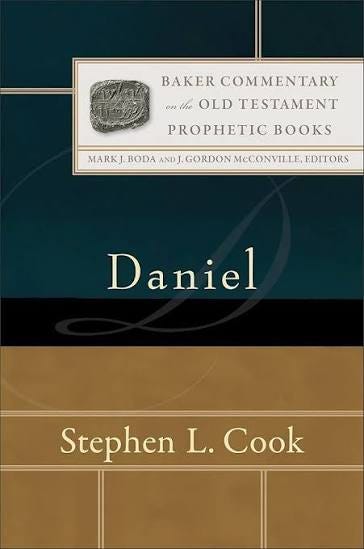
Stephen L. Cook
Daniel
Baker Exegetical Commentary of the Old Testament: Prophets
Grand Rapids: Baker, 2026).
Reviewed by Daniel Zeunert
There has been an exciting proliferation of Daniel commentaries and publications in the past decade. Although many would like to think that key controversies in the book of Daniel have been, ‘laid to rest,’[1] there doesn’t seem to be any slowing down in the contested issues of prophecy, date and composition. Stephen Cook’s contribution to the milieu of Daniel studies is a welcome addition. While he does deal with the usual controversies, it is his expositional focus that is the real benefit to scholars and pastors alike.
Right from the outset, this commentary owns the reality of the spiritual dimension present behind the book of Daniel. According to Cook: ‘There is no other way to read the text respectfully than to take seriously its assumptions about an unseen sapiential dynamism undergirding the cosmos.’[2] This is a humble and sober approach. Even many confessional commentators find the apocalypticism in Daniel difficult to accept, and certainly it’s impossible for mainstream scholars to square the visions and prophecy with a rational materialistic worldview. So, Cook’s honesty in accepting these metaphysical premises makes sense given the supernatural elements present such as the prophetic visions of the four kingdoms in Daniel 2 and 7, and the writing on the wall in Daniel 5. It’s difficult to take the book of Daniel seriously as a piece of literature when one assumes that several pseudonymous authors fabricated these apocalyptic sections, especially since they punctuate the text so frequently.
An emphasis that is consistent throughout this whole commentary is the theme of wisdom. The connections between Daniel and Joseph are made: the ability to interpret dreams; unfairly imprisoned; rising to prominence in a foreign empire. Regarding the writing on the wall in Daniel 5, in his distinctive verbose style, Cook says: ‘this foreshadows the ultimate triumph of the ideal holism embedded in the world’s transcendent foundation in wisdom, in its “sophianic” substratum.’[3] Scholars who take a pervasive view of wisdom literature in the Hebrew Bible across traditional corpus lines will appreciate this commentary’s identification of wisdom-like elements throughout Daniel.
Cook offers a refreshing acceptance of exegetical specificity regarding the numbers in the book of Daniel. Too often, commentators are satisfied to allow the numbers in Daniel - such as the 2,300 evenings and mornings in chapter 8 or the 1,290 and 1,335 days in chapter 12 - to remain enigmatic. While it is foolish to think we can claim any certainty in decoding these numericals, it is equally disrespectful to the text to dismiss these numerals as unimportant or irrelevant. After all, Daniel took numbers seriously. He takes the seventy year period of exile at face value (Jeremiah 25:11-12; Daniel 9:2), and he discerns in chapters 2 and 7 that 4 separate aspects of each vision map onto precisely 4 kingdoms. So, when Cook indulges in speculative theories about Pythagorean numbers present in Daniel 12, some may hesitate or recoil, whereas I welcome the theories. It doesn’t take much scholarly prowess to merely throw one’s hand up in the air and say that we can never know for certain therefore let’s not even bother to try to understand. Having said that, Cook doesn’t exactly nail his colours to the mast on which theory is most convincing, but at least he offers his readers something to sink their teeth into.
The ‘date and composition’ section of any Daniel commentary is often the first to be consulted. Even though this commentary doesn’t attempt to give a comprehensive assessment to this matter, it would do better to acknowledge strengths and weaknesses of both Maccabean hypothesis and the early date of Daniel. Both views have difficulties, but sometimes scholars choose a side and argue unyieldingly for it even when the evidence occasionally may point to the contrary. This commentary employs an awkward combination of the Maccabean hypothesis of composition, while retaining the divine authenticity of the prophecies. Cook anticipates criticism on this point: ‘In taking this middle way, I suspect that cautious and methodical scholars on both the right and the left will accuse me of departing from standard historical norms and methods.’[4]
The Maccabean theory usually comes part and parcel with a certain identification of the four kingdoms in chapter 2 and 7. Since the alleged pseudonymous author of Daniel was writing during the Maccabean crisis in the 160s B.C., the only options for the four kingdoms are: Babylon, Media, Persia and Greece. The traditional identification of the four kingdoms are Babylon, Medo-Persia, Greece and Rome, which is the typical view of those holding to a Babylonian provenance of the book. Cook seems to want to have his cake and eat it too by saying that both views are legitimate. ‘Archetypes constellate in multiple ways! Why not this way?’[5] While it is true that typological study of the Old Testament necessitates some texts having multiple referents, this combination of views invites an historical relativism that is foreign to the book of Daniel.
Finally, the messianism present in the book of Daniel gets the treatment it deserves in this commentary. While others baulk at any claims that Jesus might fulfill prophecy in Daniel, Cook unabashedly views Daniel’s ‘Son of Man’ through a Christological lens. ‘What we have seen in Dan. 7 and at Qumran … shows the plausibility of Jesus’s embracing a conception of radically transcendent messiahship.’[6]
Stephen Cook has done a service to both mainstream and confessional scholarship by this new Daniel commentary. All will be challenged and sharpened by his research. At times it is a dizzying experience as he fluctuates between the expected norms of a Daniel commentary, and it seems that was fully intended.
[1] For example, many see John Collins as the touchstone of Daniel scholars. He says that issues of the composition and dating of the book of Daniel were laid to rest in the late 19th and early 20th centuries. John J. Collins & Peter W. Flint (eds.) The Book of Daniel: Composition and Reception. VTSup83 (Leiden: Brill, 2001–2), 1-2.
[2] Cook, Daniel, 15
[3] Cook, Daniel, 176
[4] Cook, Daniel, 7.
[5] Cook, Daniel, 83.
[6] Cook, Daniel, 244.
I pay all due respect to the author and the writer of a concise and intelligent review; I do think its important scholarship.
BUT, the problem is always this -
no one can ever comprehend the inherently incomprehensible. If God wants us to use the likes of the book of Daniel et al, but no one can get even close to understanding it, then might that god might be unworthy of our worship??
This is made more relevant now as unhinged faith groups in real time reference these texts to encourage jaw dropping human suffering in the middle east.