
The Intertestamental Dark Ages?
Four books about the history, religion, and texts between the OT and the NT

The gap between the end of the Old Testament and the beginning of the New Testament is often perceived as a kind of “dark age” during which nothing significant occurred for approximately four hundred years.
But this is not the case!
The “intertestamental” period was a crucial time in Jewish history, marking the formation of Judaism, and providing the context for Jesus and the early church.
Fortunately, some very good books have been written on this subject!
A clear favourite of mine is by Matthias Henze on Mind the Gap, where the gap in question is that which exists between the OT and the NT!
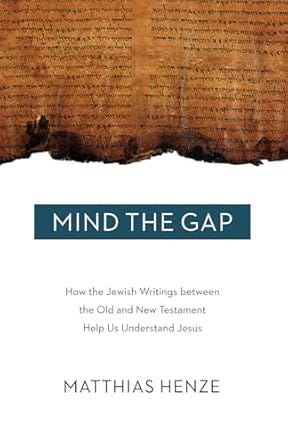
Henze provides a little bit of history about the Persian, Hellenistic, and Roman periods. But he mainly focuses on the key writings of this era such as the Dead Sea Scrolls, the Septuagint (Greek Translation of the Hebrew Bible), the Apocrypha, the collection of writings known as 1 Enoch, and texts like the Psalms of Solomon.
Henze makes a distinction between the religion in the Old Testament (Israelite religion) and the religion drawn from the Old Testament (Judaism). In other words, Jewish belief and practice in the 8th century BC is not the same as in the 1st century AD!
Henze acknowledges the continuities as well, people are after all still quoting the OT, but some things are very different: messianic expectations, belief in resurrection, Jewish factions like Pharisees and Sadducees, speculation about angels and demons, Hellenistic influences, Roman power, etc. This is the “Judaism” that is different to the Israelite religion of the past.
What is more, Jesus and the apostles were firmly “within” this Judaism, so much so that we should remember that “Judaism did not die on the cross … It has continued to exist beyond the first century.”
As an example, Henze shows that messianism is at best germinal in the OT with hopes for a continuing Davidic line and a restoration of a Davidic kingdom. It is during the intertestamental period that messianic hopes emerged, evolved, diverged, and came to fruition in the claims and ministry of Jesus. He shows that the Dead Sea Scrolls illuminate Jesus as a messianic claimant. This was music to my ears, see my books Are You the One Who is to Come? and Jesus is the Christ: The Messianic Testimony of the Gospels!
There are chapters on demons and the afterlife, but the best one was on “Did Jesus Abolish the Law of Moses” (for more on this, see Paul Sloan’s Jesus and the Law of Moses). He points out that most Christians today do not obey the Jewish Law and so they assume that Jesus must have abolished it!
To which he responds that the Pharisees were a complex group and not just a paragon of legalism. The Evangelists do tend to stereotype the Jews in light of the sectarian polemics of their own day. And most important of all, Jesus never said anything about abolishing the law; in fact, if you read Matt 5:17-21, it is the exact opposite of abolishing the Jewish Law! In the antitheses of the Sermon on the Mount, Jesus does not overturn the law, but articulates the ideals inherent within the law. Plus, Jesus reveals what the law is all about: the promise of life and attainment of perfection: be perfect as your heavenly father is perfect! Also, Jesus debated, as others did, what were the weightiest matters of the law, not whether the law was good or bad.
Then, Henze tries to do the same with Paul and the law, largely looking at Romans. Now Paul does come across as very pro-law in Romans (see Rom 3:31 - “Do we then nullify the law through faith? Absolutely not! On the contrary, we uphold the law”). But Galatians is a little more radical and I think the topic of Paul and the law is much more intricate and complex esp. if you do a survey of Galatians. On which, see Brian Rosner on Paul and the Law for a good read!
Henze believes a modern rethink of ancient Judaism vis-a-vis Christianity was caused by three things: (1) The holocaust, perpetuated by an allegedly Christian nation; (2) the discovery of the Dead Sea Scrolls; and (3) increased opportunities for Jewish-Christian dialogue.
Henze challenges readers to become familiar with things they are unfamiliar with, Jews and Judaism, Jewish traditions and texts, scriptural interpretation, and ask how that illuminates Jesus and the New Testament.
Read Henze’s interview with James McGrath and listen to his interview with the Onscript crew.
For a more rigorous summary of the history between the end of the OT and the beginning of the NT, you cannot go passed George Athas’ book Bridging the Testaments.
Henze’s Mind the Gap is good for beginners, but if you already know about Persians, Greeks, Hasmoneans, and Pompey, and if you want something more in-depth, then this is my # 1 recommended book.
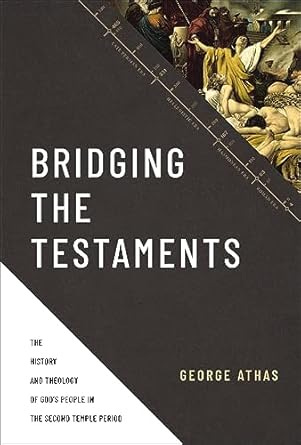
Spanning the close of the Old Testament and the dawn of the New, Athas’ volume explores the history and theological currents of four key phases in Israel’s post-exilic story: the Persian (539–331 BC), Hellenistic (332–167 BC), Hasmonean (167–63 BC), and Roman (63–4 BC) periods. By tracing these epochs, Athas challenges the traditional claim that the centuries before Jesus were marked by prophetic silence or a kind of darkness before the breaking light.
Athas does a good job mapping the political, social, and religious transformations of these four eras, explaining key persons, events, and the major texts. Drawing on a wide array of biblical and historical sources, Athas reconstructs the history of Judah and Samaria, illuminating the unfolding story of God’s covenant people and the theological shifts that carried Israel from the Old Testament into the New.
In sum, the book unites the Old and New Testaments by tracing five centuries of historical and theological continuity with developments, revealing also how the story of God’s people progressed rather than simply being paused between the testaments.
If you want something in between Henze (beginner) and Athas (advanced) then George Nickelsburg’s Ancient Judaism and Christian Origins is a good medium.
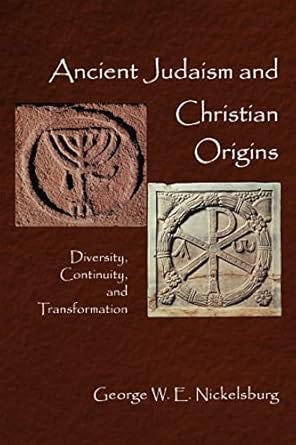
This is another good book, a little older now, but it engages in excellent comparisons between Jewish texts and the New Testament. It is not a historical narration or a literary survey, instead, Nickelsburg plots Christian origins in the context of ancient Judaism. When I first read this book decades ago, I found it richly informative and it helped me to think historically rather than using theological categories to explain everything.
Nickelsburg organizes his discussion around a number of traditional topics: scripture and tradition, Torah and the righteous life, God's activity on humanity's behalf, agents of God's activity, eschatology, historical circumstances, and social settings. Each of the chapters discusses the findings of contemporary research on early Judaism, and then sketches the implications of this research for a possible reinterpretation of Christianity.
Finally, I have to give a mention to David deSilva’s book about the Jewish texts and teachers who influenced Jesus, James, and Jude!
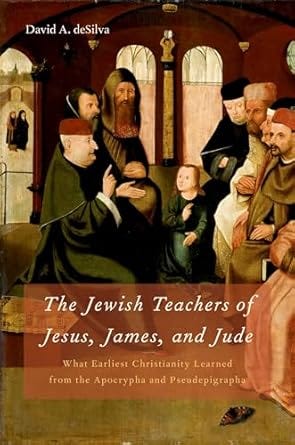
I return to this book time and time again when I want to remember how intertestamental texts influenced the New Testament. For instance, recently I’ve been looking at the influence of 1 Enoch on the epistle of Jude and deSilva’s Jewish Teachers was my natural starting point!
The strength of the book is that deSilva introduces readers to the ancient Jewish writings from the Apocrypha and Pseudepigrapha and examines their formative impact on the teachings and mission of Jesus and his half-brothers, James and Jude. Knowledge of this literature, deSilva argues, helps to bridge the perceived gap between Jesus and Judaism when Judaism is understood only in terms of the Hebrew Bible (or ''Old Testament''), and not as a living, growing body of faith and practice.
So, yes, another one to add to the reading list!
You've convinced me that I need to circle back to this period and gain a deeper knowledge as to how 1st C Judaism developed - not just the chronology of events, but also the developing thoughts and expectation as reflected through extrabiblical texts. Perhaps acquiring that perspective is more valuable in understanding the NT than from what we learn from 2nd Century Christian writings. But all that background work takes a lot of time and focus. How I wish I could just suck all the knowledge from these books into my head.