

Sing a New Ode to the Lord
1 I raised my arms on high on account of the grace of the Lord.
2* Because he cast off my chains from me, and my Helper raised me according to his grace and his salvation.
3 And I stripped off darkness, and put on light.
4 And even I myself acquired members. In them there was no sickness or affliction or suffering.
5 And abundantly helpful to me was the thought of the Lord, and his incorruptible fellowship.
6 And I was lifted up in the light, and I passed before his face.
7* And I was constantly near him, while praising and confessing him.
8 He caused my heart to overflow, and it was found in my mouth; and it sprang forth unto my lips.
9 Then upon my face increased the exultation of the Lord and his praise.
Hallelujah.
Od. 21.1-9. Trans. J.H. Charlesworth
These poignant verses introduce us to a text that remains one of early Christianity’s most beautiful yet least explored treasures. So in this post, we are exploring one of the most fascinating and overlooked documents from the earliest centuries of Christianity: The Odes of Solomon.
There is a fascinating interview with James H. Charlesworth about his career which has frequently engaged in translation, study, and research on the Odes of Solomon.
Introduction
The Odes of Solomon are a collection of 42 hymns, probably deriving from Syria in the second century, and they are our earliest Christian hymnal, a compilation of songs that believers in Jesus sang together as they gathered to celebrate their faith somewhere in the cities and towns of ancient Syria.
The story of how these ancient hymns came to modern attention reads almost like an adventure novel. For centuries, the Odes of Solomon existed only as scattered quotations in patristic sources. Church fathers like Lactantius mentioned them (Div. Inst. 4.12.3), but the complete collection had vanished from the historical record.

Then, in 1909, British scholar J. Rendel Harris made an extraordinary discovery in a Syriac manuscript purchased from a monastery near the Tigris River. This manuscript, dating to the fifteenth or sixteenth century, contains the majority of the Odes. The scholarly world was electrified and a spate of publications followed soon after. Here was a substantial corpus of early Christian poetry that had been lost for over a millennium.
Subsequent discoveries added to our knowledge. A Greek papyrus fragment dating to the third century was found containing Ode 11, and five additional Odes appeared in a Coptic codex within a Gnostic writing known as Pistis Sophia (Od. 1, 5, 6, 22, and 25). These multiple attestations of the Odes (in Syriac, Greek, Coptic, and Latin) demonstrate the Odes’ widespread circulation in the ancient world.
Origins
When were these hymns composed? This question sparked considerable scholarly debate after their rediscovery. Today, thanks largely to the meticulous work of scholars like James Charlesworth and Michael Lattke, we have reached a broad consensus. (I had the pleasure of knowing Michael Lattke when I was at UQ and he gifted me a copy of his Hermeneia volume).
Generally, the date set for the Odes composition is about 100-125 AD. 100 if you ask Charlesworth, but Lattke prefers the later date of 125. Both agree however that they were written in Syriac and somewhere in the vicinity of eastern Syria.
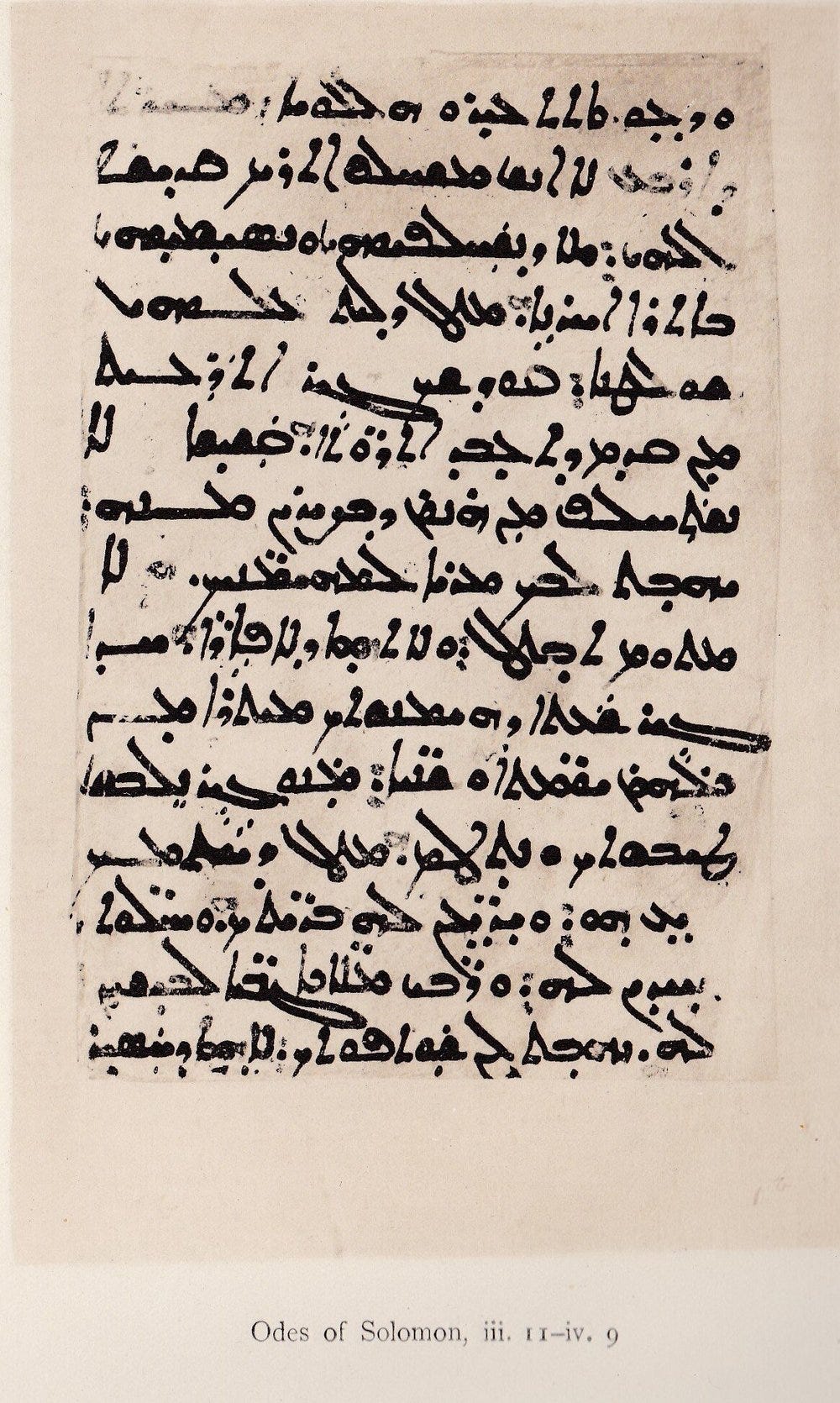
The Odes were written, says Lattke, “when early Christianity was still largely embedded among the varieties of early Judaism” (Lattke, 13). The odes breathe the air of Eastern Christianity, likely composed in or near Antioch or Edessa, the great centers of Syriac-speaking Christianity.
This linguistic evidence places the Odes within the cultural orbit of ancient Syria and the Levant. It attests a Christianity that developed distinctive theological and liturgical expressions somewhat independent of Western trajectories. The Odes also display a rich, symbolic language that resonates with Jewish mystical traditions, but with a distinctively Christian interpretation, many of which were conducive to later Gnostic language.
Authorship
Who wrote these extraordinary hymns? We simply don’t know!. The collection is attributed to Solomon not because the ancient Israelite king actually wrote them, but because the author tries to imitate a Solomonic style of wisdom and worship. In ancient Israel, Solomon was known as “the Beloved,” and the “odist,” as scholars call the anonymous author, uses this persona to refer to himself and all believers in the Lord Jesus.
What we can discern is that the author was almost certainly a Jewish Christian. This is evident from a strong Jewish character of these hymns, their deep roots in Hebrew wisdom tradition and their employment of distinctly Semitic literary devices. The Odes contain multiple similarities to writings found at Qumran and to the Gospel of John. So it is a kind of like Qumran’s Thanksgiving Hymns and the Gospel of John put in a blender!
Purpose
The purpose of these hymns was probably liturgical. They were written specifically to be sung or chanted in worship settings.
Importantly, the Odes not only praise God and the Lord, but they also possess a distinctive, deeply personal and experiential quality. The Odes stress the mystical encounter with the divine. There are repeated themes of light, knowledge, ascending to heaven, putting on Christ, and drinking from the divine fountain all indicative of profound spiritual experienced and inner renewal.

Main Themes
Several major themes run throughout the collection.
