
The Pope Drops Spiritual Knowledge on AI

Like many of you, I was excited to read Pope Leo XIV’s encyclical Magnifica Humanitas on AI, humanity, and Christian witness in a digital age.
As someone who is wrestling with AI as a theologian and educator, this topic has been much on my mind, and Pope Leo XIV has deployed the resources of the Catholic tradition to address it head-on.
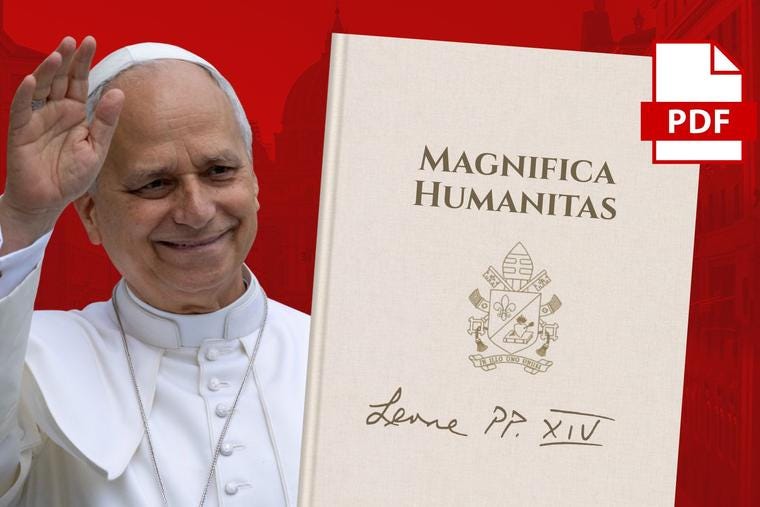
Below you’ll find my assessment, a short video about AI and education, and my summary of the document.
TLDR
The Pope warned that while AI is a powerful tool, as with all technologies, it is not a morally neutral tool. We can use AI to build a new Tower of Babel, a monument to our own self-aggrandizement, or we can be like Nehemiah and rebuild the walls of Jerusalem, create a new city of God for all of humanity. He urges people to think about AI in light of a common good, the purpose of earthly goods, human dignity, subsidiarity, and solidarity.
Leo even says AI must be “disarmed” of its ability to cause harm: The gravest harm is “the pervasive technocratic paradigm in which we are immersed, and that is amplified by the digital revolution and AI, threatens to normalize an anti-human vision.” His main concerns are:
The Risk of Dehumanization
The Concentration of Unprecedented Private Power in the Hands of a Technocratic Elite
Exacerbation of Global Inequalities
The Illusion of Eliminating Human Vulnerability Through Transhumanism
Threats to the Dignity of Work
The Distortion of Communication and Truth
Pope’s Warning to Educators
Summary of Magnifica Humanitas
Pope Leo XIV warned that AI risks leading us into a technological tower of Babel whereas our great human need is to dwell in the city of God.
Each generation inherits the task of shaping its own era, of guiding history toward becoming a place where the dignity of every person is safeguarded, justice is promoted, and fraternity is made possible. Yet every era also runs the risk of creating a more inhumane and unjust world. Whenever humanity is in danger of marring its true identity, we Christians lift our eyes to the Incarnate God (§ 1).
Human collaboration is a noble endeavour in order to build a more just world and to corporately pursue the aspirations of humanity (§ 2)
Just as Pope Leo XIII published the encyclical Rerum Novarum in 1891 to address the industrial age and modern world, now Pope Leo XIV, wishes to address the technological innovations of the day in light of the wisdom Sacred Scripture and Tradition, which is “not an inert set of concepts, but a living corpus of truth that safeguards and interprets humanity’s vocation to a full and just life” (§ 3).
Technology can improve human living conditions, but technology is not without moral ambiguity or risk (§ 4). It is not the technology alone that poses a danger, but the potential of non-state and even private actors to wield it (§ 5). The spiritual and cultural roots of these technologies need to be examined as well as their long-term implications (§ 6).
Technology can become an ignoble self-aggrandizing project like the Tower of Babel or a community-building project like Nehemiah rebuilding the walls of Jerusalem (§ 7-8). Thus:
Technology has the power to heal, connect, educate and protect our common home; but it can also divide, exclude and generate new forms of injustice. In the abstract, technology in and of itself is not a solution to humanity’s problems, just as it is not inherently evil. In practice, however, technology is never neutral, because it takes on the characteristics of those who devise, finance, regulate and use it. Therefore, the primary choice is not between a “yes” or “no” to technology, but rather between constructing Babel or rebuilding Jerusalem; between a power that claims to dominate the heavens and a people who work together in the presence of God to rebuild the walls of fraternal coexistence (§ 9).
Accordingly, says Leo, we must choose the “way of Nehemiah,” which highlights the importance of working together to make the City of God a safe place for returning exiles (§ 10).
To build for the common good requires; first, a firm relationship with God; second, accepting the limits and weakness of humanity; third, courage and cooperation; and fourth, to use “evangelical” (i.e. gospel) language in order to think through new technologies in light of “the dignity of the human person, the universal destination of goods, the preferential option for the poor, care for our common home and peace” (§ 11-14).

AI threatens new forms of de-humanization, so Pope Leo exhorts all people as the Patriarch of Rome, “With the heart of a shepherd and a father, I ask everyone to abandon the construction of yet another Tower of Babel and to join forces in building up the common good, so that humanity will never lose its beauty, and the world once again will come to recognize the human heart as the place where God desires to dwell” (§ 15-16).
Importantly, Leo believes that the church cannot exist outside of the earthly realities – political, social, cultural, and technological – that effect people. That is because “the Church actively participates in the processes by which society grows and is organized, and she offers her own contribution to the creation of a more just and fraternal society” and therefore “The Church thus stands alongside the world without overpowering it, so that the promise of justice and peace that the Holy Spirit continues to sustain in the heart of humanity may come to fruition in every human endeavor” (§ 19-20)
The document then provides an overview of the development of Catholic social doctrine as a kind of living and growing corpus of tradition which each pontificate adds to. It notes the bedrock of the Triune God’s communion of persons in love, Jesus Christ as the one who unites us with the love of the father, and human beings in the image of God so that “Human dignity does not depend on a person’s abilities, wealth or position in life, nor on the right or wrong choices made; instead, it is a gift that precedes and transcends each person, endowed by God as an expression of his unfailing love” (§ 48-50). Human life has intrinsic value, not an acquired, functional, or productive value, because everyone is loved by God (§ 51). It is “not enough to state simply that men and women have equal dignity and rights; it is necessary that this be reflected in concrete decisions, such as in laws, access to employment, education, social and political responsibilities, and the way society listens to and values women’s contributions” (§ 57).
Leo’s response to new technologies comes down to the pursuit of a common good for the world’s diverse array of peoples, the right of every person to access the earth’s natural goods, which now includes “new forms of property, such as patents, algorithms, digital platforms, technological infrastructure and data” (§ 67). As well as subsidiarity, which in practice means shared responsibility for how society is run, so that decision making about technology should be democratized. Subsidiarity is rooted in solidarity, we are all connected to each other and responsible for each other. “When subsidiarity is not linked to solidarity, it ends up becoming merely the protection of particular interests; when solidarity is not supported by subsidiarity, it degenerates into a form of welfare that does not foster responsibility” (§ 73).
A key line from the encyclical talks about the importance of viewing AI through the lens of social justice:
Justice demands that we prevent the emergence of new forms of exclusion and deprivation of freedoms: individuals and peoples hindered or denied access to basic technologies, communities exposed to invasive surveillance and social groups penalized by opaque algorithms that perpetuate prejudice and discrimination. In the digital age, a just social order guarantees everyone equal access to opportunities, protects the youngest and weakest members of society, combats hate and misinformation and subjects the use of data and technology to public oversight, so that the guiding principle is not solely profit but the dignity of every person and the common good of all people (§ 80).
While new technologies like AI can aid in human development, “Technological innovations, including artificial intelligence, are not neutral, for they can either foster participation and justice or exacerbate inequality, control and exclusion. For this reason, they must be evaluated by asking a crucial question: Do they truly help individuals and people to become more humane and fraternal, while respecting our common home and future generations?” (§ 85).

Pope Leo challenges us on how we will use AI: “As technological development rapidly transforms languages, relationships, institutions and forms of power, we believers must and can choose which projects to work on and in what manner, so as to safeguard and value the grandeur of humanity that has been given to us as a gift” (§ 90)
If humans are not good at wielding power, then the same is true of technocratic power, esp. in the hands of a few (§ 92-96).
On AI, because of the rapid pace of technological advancements, we need deepening scientific research married to spiritual and moral discernment (§ 98). Also, AI is not human intelligence, because AI is a mimic of human intelligence, not an embodied version of it:
So-called artificial intelligences do not undergo experiences, do not possess a body, do not feel joy or pain, do not mature through relationships and do not know from within what love, work, friendship or responsibility mean. Nor do they have a moral conscience, since they do not judge good and evil, grasp the ultimate meaning of situations, or bear responsibility for consequences. They may imitate language, behavior and analytical skills, or even simulate empathy and understanding, but they do not understand what they produce, for they lack the affective, relational and spiritual perspective through which human beings grow in wisdom (§ 99).
AI is a “valuable tool” but needs “a measured and vigilant approach” (§ 100) as it can easily displace “personal creativity and judgment” and dislocate the human desire “to form genuine human connections” (§ 101). AI’s need for resources to operate means it risks depleting our natural resources which requires “sustainable technological solutions that reduce environmental impact and help protect our common home” (§ 101). AI may also deceive as it might claim or be claimed for it to have a more objective point of view when in fact “they end up reflecting and reinforcing the stereotypes or ideological bias of their designers and developers” (§102). Thus: “we cannot consider AI to be morally neutral” (§ 104).
A technocratic elite cannot alone provide the moral framework for AI since “AI tends to amplify the power of those who already possess economic resources, expertise and access to data” (§ 108). AI needs to be guided by a common good, universal goods, subsidiarity, and solidarity.
Leo even says AI must be “disarmed” of its ability to cause harm: The gravest harm is “the pervasive technocratic paradigm in which we are immersed, and that is amplified by the digital revolution and AI threatens to normalize an anti-human vision” (§ 111). Even worse, AI potentially “makes us more isolated and more vulnerable to being dominated and excluded,” which shows that when AI “becomes self-referential, its true purpose of serving life and the human person is lost” (§ 113). However, “To disarm does not mean rejecting technology, but preventing it from dominating humanity. It means freeing technology from monopolistic control and opening it to discussion and debate, therefore making it human-friendly and restoring it to the plurality of human cultures and ways of life” (§ 110).
On the one hand, “technological innovation can represent human participation in the divine act of creation,” yet “developers are called to embed values in their projects with due seriousness: with transparency, responsibility toward affected communities and careful attention to ensuring that what is being cultivated is a genuine good” (§ 111).
There is a big rejection of Transhumanism and posthumanism which you can read at your own leisure (§ 115-28)
In application, Leo expresses reservations as to how AI can influence public and political communication. AI creates a world where truth can be constructed and therefore can yield a crisis of truth and even of democracy: “Indifference to the truth leads, slowly but surely, to a descent into totalitarianism” (§ 132-34).
Leo says: “Our first task is neither to demonize nor idolize technological tools, but to utilize them on the basis of a fundamental principle, namely that truth is a common good and not the property of those with power or influence” (§137). Yet we need “an ecology of communication” complete with ethics, intermediary organizations, and journalism to scrutinize AI providers and tools.

Thereafter, Leo expresses concern about the health risks associated with social media and screen time for youth, whereby “The pervasiveness of digital media fosters a culture of immediacy and hyper-stimulation, which gives rise to fatigue, boredom and apathy concerning the effort required for seeking the truth” (§ 139). Then there is cyber-bullying, isolation, and AI-generated pornography. Added to that, AI has limits, data is not truth and processing is not thinking. Therefore, “” (§ 140).
Leo understandably warns about the economic impact of AI on the working class which has been a Catholic concern since the 19th century. Yes, AI can lead to new opportunities, but we also need to value human labor, dignity, contribution, and sense of vocation (§ 151-69).
Other concerns are voiced about how digitization will effect human freedom and mental health (§170-81): “At the root of these problems lies a technocratic and post-humanist mentality that tends to regard the human person as an object to be manipulated or a resource to be optimized, removing all safeguards against the unchecked pursuit of profit” (§ 172).
It includes, as well, a striking statement apologizing for the Catholic Church’s failure or slowness in condemning slavery as an institution (§ 176). There is also concern issued about the use of AI in warfare esp. in hybrid warfare (§ 182-203).
I think the climax of the encyclical is a LOTR quote:
The twentieth-century Catholic author J.R.R. Tolkien, in the words of a protagonist in one of his novels, described our responsibility in this way: “It is not our part to master all the tides of the world, but to do what is in us for the succour of those years wherein we are set, uprooting the evil in the fields that we know, so that those who live after may have clean earth to till.” The civilization of love will not arise from a single or spectacular gesture, but from the sum total of small and steadfast acts of fidelity that serve as a bulwark against dehumanization. For this reason, it is worthwhile pausing to reflect on some aspects of how we, each in our own way, can cooperate in building the civilization of love (§213)
The conclusion calls people to an authentic Jesus-shaped humanity and to build a civilization of love, with AI, but not in slavery to AI. The Pope urges us to use the gospel as a compass in the digital era. He tells us to commit to the truth and to an education on how to use AI and retain rather than forfeit our humanity. We need to cultivate relationships, not fragmentation. We need justice and truth. We need to be like Nehemiah, building Jerusalem.
It ends with the words:
With the same faith as Mary, let us become “weavers of hope” in our world, sharing who we are and what we have, so that the presence of Jesus may grow among his Kingdom and we take shape. In the humble fidelity of daily life, even the era of AI can become a time in which the Holy Spirit brings about the civilization of love in our lives. Indeed, the Lord continues to make all things new and offers every era the possibility of becoming part of salvation history in the light of the Incarnation. I entrust our desire to the Mother of Christ, to the Woman of the Magnificat, that she may guide our steps through this time of change and preserve in each of us true faith in the Gospel, so that we may bear witness to the grandeur of humanity, in which God has made his dwelling. (§245)
I increasingly like this Pope. I think he is a smart, reflective and prayerful man seeking to emulate Christ. I think he will become increasingly important in the coming months and years in what is playing out in the USA and around the world.
I think his predecessor and the conclave knew this would be the case too.
I agree with this encyclical, also.