
To Overthrow the World
The Rise and Fall and Rise of Communism

George Bernard Shaw wrote: If at age 20 you are not a Communist, then you have no heart. If at age 30 you are not a Capitalist, then you have no brains!
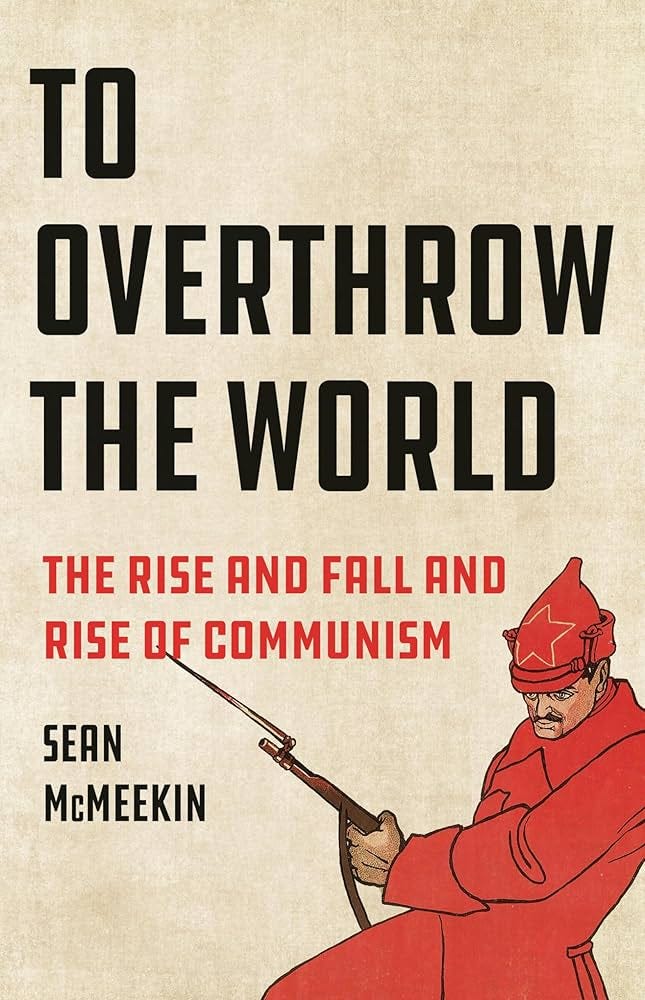
Sean McMeekin’s history of communism, To Overthrow the World, is a must-read tour de force. It’s easily the best book I’ve read this year so far!
On his purpose, McMeekin says: “The history of Communism may not always be edifying or reassuring, but it is worth reexamining dispassionately, without either prejudice or wishful thinking” (6). It is not a populist right-wing denunciation of communism. It is a historical description of what communism is, how it gained power, combined with a political critique of communism for its failures, rampant oppression, and continual violence.
In fact, the # 1 takeaway from the book is that violence is a feature, not a bug, of communism. Communist regimes only exist because of the sword, and once that sword runs out of money, if it breaks, or is sheathed, then communism always falls.
McMeekin believes Marxism emerged from an eighteenth-century synthesis of the Christian ideal of renouncing material possessions and the Platonic ideal of the collective-minded political community. I’d argue that the Christian roots of Marxism are even deeper, especially if you look at the Book of Acts, the social ethics of the Cappadocian fathers, and protest movements like the 13th-century English “diggers.” But he is right that Marxism in particular emerged out of a fusion of Christian eschatology about a future paradise and philosophical rationalism about the body politic, fostering a belief in natural progress towards a better world.
The French Revolution is the Cromagnon man of Marxism, the link between the anti-wealth polemics of Medieval Christianity, burgeoning notions of equality and rights, ready to join hands with Hegel’s dialectic philosophy, the revolutionary activity of 1848, and Marx’s materialist economics. Importantly, the French Revolution also anticipated the violence of communist revolutionaries and regimes.
Marx’s manifesto was explicit in arguing that everyone in society must be classed as either oppressor or oppressed, that total revolution necessitates political violence with “despotic inroads.” His belief in the “equal liability of all to labour” would be used to justify forced work camps and even slave-labour.
Marx was not just doctrinaire, believing his ideas were right and everyone else was wrong; he demanded total control of the organizations he was a part of and did not tolerate dissent or rivals. Hence the rupture between the Red (communists) and the Black (anarchists). Anarchist leader Mikail Bakunin was right about the communists: “As soon as they become rulers, they will cease to be workers and will begin to look upon the whole workers’ world from the heights of the state. They will no longer represent the people but themselves and their own pretensions to govern the people.” He claimed that doctrinaire revolutionaries like Marx intended “to overthrow existing governments and regimes so as to create their own dictatorship on their ruins.”
Older Post: A Christian Critique of Communism
“Every person I’ve spoken to about their life under communism describes communism as a machine filled with horrors and hopelessness, where people are controlled by fear and terror, where there are no rights, and you can be de-personed and dissolved at any moment.”
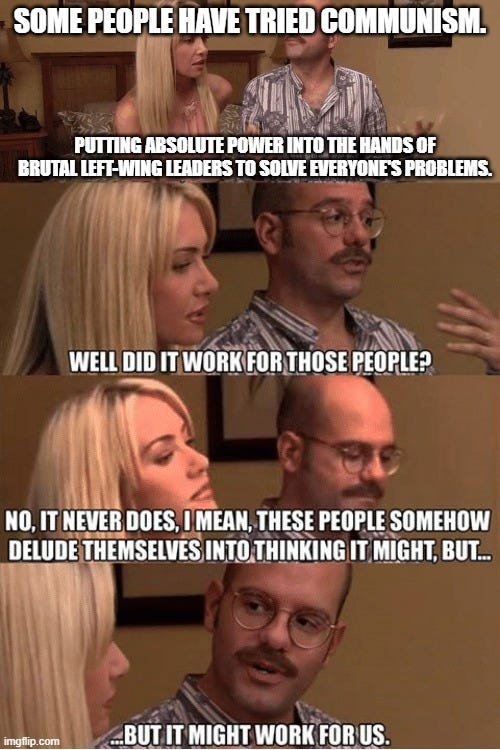
If there is one thing that created global communism, it was World War I. In many ways, it proved something that Marx had said, that most governments regarded their workers as merely pawns and tools to construct their own capitalist and imperial projects. The crisis and carnage of WWI gave Lenin the opportunity he needed, thanks to German support, for launching a successful communist revolution in Russia.
Funnily enough, when the Bolsheviks took over St. Petersburg and Moscow, due to bank staff going on strike, one of their first activities was to employ strikebreaking tactics to force them back to work! Notably, Lenin, Trotsky, and eventually Stalin had no qualms about killing adversaries, dissenters, former allies, striking workers, peasants, shopkeepers, refugees, and literally anyone who got in their way at a certain time. After WWI, it was the courageous Poles, who stopped the Red Army from advancing into Europe!
A common story is that there is a massive and violent repression of the populace by the secret police and army, then the secret police and army get blamed for the repression, and the authorities then empower former victims to purge the secret police and army. This is what happened under Stalin and Mao! It was a great trick. Get people to do the killing for you, then hand the killers over to the surviving victims because you were wrongly advised!
McMeekin points out that the Communist-Islamist alliance goes back to 1920 and a “Congress of the Peoples of the East” held in Baku, Azerbaijan. It was intended to stir up a Marxist-Muslim holy war against Western imperialism. I’d argue that, based on recent events, it has been more successful in the twenty-first century than in the twentieth century!
I learned a lot from this book:
I did not know that after WWII the Russians were given money, property, and slave labor from countries like Romania as reparations!
Mao wanted a world-war for communism which he believed could kill up to half of the world’s population.
What made Cambodia’s Khmer Rouge so chilling was their “year zero” idea of grinding down society into a shared state of poverty and misery in order to achieve true equality.
China was poorer in 1976 than when the communists took over in 1949.
Due to the one-child policy, China performed 14.4 million abortions, many of which were late term.
China in 1985 had only 20, 000 passengers in total.
Diane Feinstein’s husband, Richard Blum, was given an 18% share in the Shezhen Development Bank.
What brought the Soviet Union down in the 1980s was (1) The war in Afghanistan; (2) Reagan’s Strategic Defence Initiative; (3) The cost of keeping Soviet forces in Eastern Europe; (4) The cost of setting up puppet dictators in Africa and Latin America; and (5) Plummeting oil prices.
In 1991, as the Soviet Union crumbled, $150 billion was transferred into Western bank accounts for Soviet individuals.
McMeekin also raises alarm about the way that Western governments are taken to imitating China’s tyranny with an emphasis on surveillance and threats to citizens with things like “de-banking.”
Anyway, this is a great read, a wonderful gift for anyone who thinks themselves a communist or hardcore socialist.
Thanks Dr. Bird for the review. I heard about and skim this one in the book store. I don’t know how you read so much. I understand that’s your vocation to read books all the time. I wish I had more time to read. So many books so little time. By the way yesterday I finished your latest book. There was so much detail but I really like how most of your footnotes were full of scripture references. I really enjoyed and appreciated it a lot. A lot for me to think about I have learned before. I may have to read it again to understand it better.
Thanks Michael - a great article! The books sounds fascinating!
This also looks like a great critique of Marxism, focusing on the spiritual dimension:
The Devil and Karl Marx: Communism's Long March of Death, Deception, and Infiltration Kindle Edition; by Paul Kengor
Read about Karl Popper's Critique of Marxism here:
Hudelson, R. (1980). Popper’s Critique of Marx. Philosophical Studies: An International Journal for Philosophy in the Analytic Tradition, 37(3), 259–270. http://www.jstor.org/stable/4319371